Toxic Pesticides Are Everywhere: Why South Africa Must Act Now
- Published:
Toxic pesticides are everywhere: on and in your food, in your workplace, in your home, on your pets and sprayed in planes and onto city payments. They are widely used in industrial farming practices, putting farmworkers, their children and rural communities at the highest risk of poisoning exposure in South Africa.
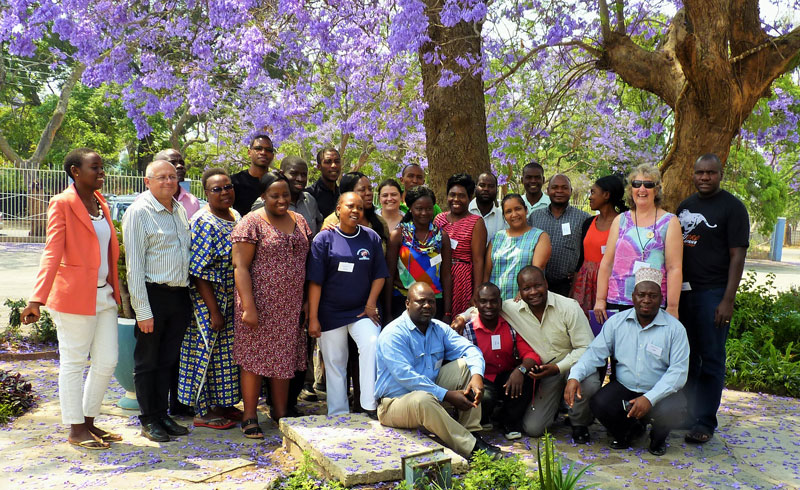
This was revealed at a two-day regional workshop on Highly Hazardous Pesticides (HHPs) in Cape Town last week run by the SAFCEI and the environmental organisation groundWork.
The extent of pesticide exposure in everyday life surprised even some stakeholders there, many of whom are fighting for policy reform. South Africa’s regulatory framework which puts crops before public health urgently needs to be updated - the law dates back to the apartheid Act 36 of 1947.
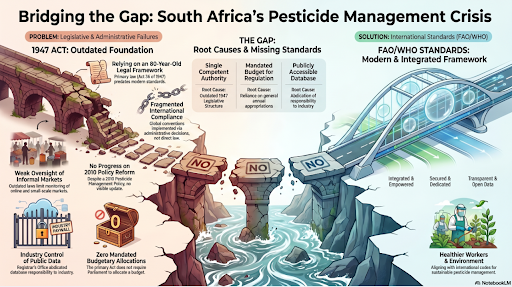
"An updated Agricultural Act that protects farmers, farm workers and public health is critical to finding a solution for South Africa", says Rico Euripidou, the chemical and campaigns support coordinator for groundWork.
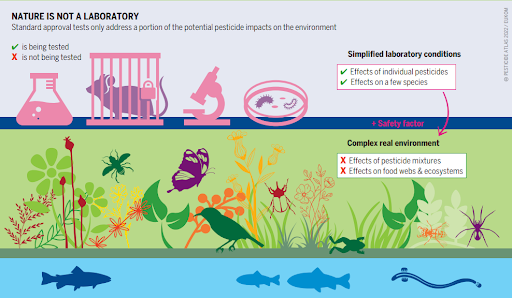
Another major concern is that the government doesn’t have the budget, trained officials or resources to enforce existing rules, and the powerful pesticide industry is rarely held accountable for harm (much like the tobacco industry in the past). Yet the dangers that HHPs and pesticides pose to public health, biodiversity in the environment and agricultural workers are massive and scientifically proven by illustrious academics, like Prof Andrea Rother at the University of Cape Town (UCT).
“The European Union (EU) has banned 116 HHPs but their export to South Africa continues to rise - from about 1,600 tons in 2018/19 to more than 2,100 tons by 2024”, said Rico Euripidou.
Pesticide use in Africa has increased 67% from 1990 to 2021 according to the Pesticide Atlas.
HHPs are among many toxic and hazardous pesticides which can be deadly as the shocking death of six children in Soweto, from the agricultural organophosphate Terbefos, proved in October 2024.
The SA government banned Terbefos in June 2025 and announced the ban of a raft of hazardous pesticides, to be phased out. But companies are exploiting loopholes (applying for exemptions or ‘derogations’) to prevent the timely implementation of this ban.
Yet agroecology is an alternative to industrial farming which works. “Agroecology is a sustainable way to grow healthy food without chemical contamination”, said Gabriel Manyangadze, SAFCEI Food and Climate Justice Manager.
Gabriel visited successful models in Southern Africa, which demonstrate that agroecology can be done at scale, particularly with right training, support, access to markets and supply chains. More than 90 field studies demonstrate this.
Most countries of the world have signed up to The Global Framework on Chemicals (2023) which sets a voluntary target to phase out HHPs in agriculture by 2035, where risks cannot be managed and alternatives exist.
All of us wanting to live in a safe, poison-free environment need to act now to hold the SA government accountable and be advocates to turn its commitment into a reality.
During the HHPs workshop, funded by The Swedish Society for Nature Conservation, 20 participants had the chance to review the state of South Africa’s pesticides management and form partnerships to work for a pesticide-free world.
They also contributed to a baseline assessment tool based on the International Code of Conduct for Pesticide Management and the LIRA Guidance. Their replies will help to identify the legal and institutional gaps in country (SA’s) systems.
The insights from South Africans and other developing countries surveyed with this tool will be presented at a side event at the first international conference on The Global Framework on Chemicals to be held in November in Switzerland.
Who we are
SAFCEI (Southern African Faith Communities’ Environment Institute) is a multi-faith organisation committed to supporting faith leaders and their communities in Southern Africa to increase awareness, understanding and action on eco-justice, sustainable living and climate change.
Featured Articles
-

South Africa: Who Ends Up Paying If DMRE Cooks the Price of Nuclear Power?
-
South Africa’s nuclear energy expansion plans continue to draw criticism, environmental NGOs chew over legal challenge
-
Earthlife Africa and SAFCEI respond to latest unsettling nuclear news regarding the ministerial determination
-
Open Wing Alliance Africa (Virtual) Summit 2023
-
The Green Connection and SAFCEI respond to energy minister's divisive and deflecting comments
-
Job Vacancy: FLEAT Coordinator